
Planting
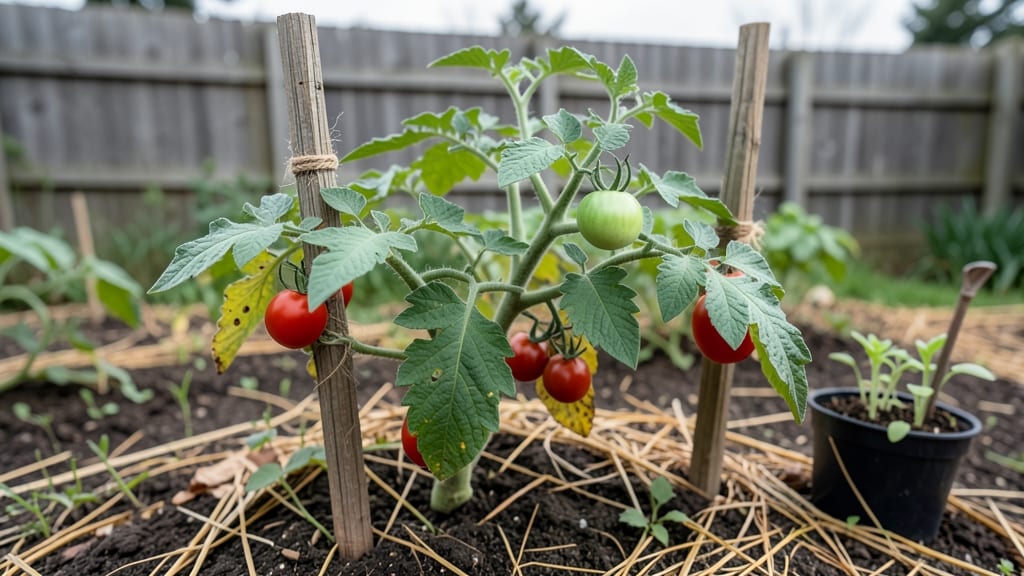
Tomato spacing in square foot gardens requires 1 plant per square foot for indeterminate varieties and 4 plants per square foot for determinate types, arranged in a grid pattern to maximize sunlight exposure and airflow. Staking or caging is essential to prevent sprawling and disease. Adjust spacing for larger varieties like beefsteaks or smaller cherry tomatoes accordingly.
Proper tomato spacing in square foot gardens isn't just about fitting more plants—it's about creating an environment where each plant thrives.
Indeterminate varieties like 'Sungold' need that extra space because they grow vertically, while compact determinate types like 'Roma' can handle tighter quarters. 🌱 The grid pattern isn't arbitrary; it ensures every plant gets equal access to sunlight and air circulation, which directly impacts fruit production.
I've found that adding a trellis or cage within the square foot can actually increase yield by 20% by keeping foliage off the ground and reducing disease risks.
For those working with limited space, consider interplanting smaller varieties like cherry tomatoes with larger ones. This way, you maximize vertical growth while still maintaining the recommended spacing. The key is to monitor plant health weekly—if leaves start touching, it's time to adjust either spacing or support structures.
This method has helped me double my harvest in just 4x4-foot blocks!
💡 In This Article
- How Tomato Varieties Affect Square Foot Spacing
- Square Foot Tomato Layouts for High-Yield Blocks
How tomato varieties affect square foot spacing
The key difference between tomato varieties lies in their growth habits. Indeterminate tomatoes like 'Brandywine' grow continuously throughout the season, reaching heights of 6-8 feet with sprawling vines that need 18-24 inches of vertical space.
This is why they require just 1 plant per square foot—their sprawling nature demands room for both foliage and fruit production. The vines also need support structures like 6-foot cages or sturdy stakes to prevent breakage from wind or fruit weight.
Determinate varieties, such as 'Roma' or 'Celebrity,' grow to a fixed height of 3-4 feet and produce fruit in clusters near the top. Their compact growth allows for tighter spacing—up to 4 plants per square foot. The reason?
Their bushier form creates a natural canopy that shades the soil, reducing moisture loss and weed growth. However, this dense foliage also means airflow is critical to prevent fungal diseases like early blight, which thrives in humid conditions.
Size matters too. Large slicing tomatoes like 'Beefsteak' need even more space—often 1 plant per 2 square feet—because their 1-2 pound fruits require robust root systems and support.
On the flip side, cherry tomatoes like 'Sungold' can handle 4-9 plants per square foot because their 1-inch fruits are lighter and the plants stay more compact. The trade-off? Cherry tomatoes produce more fruit per square foot but with smaller individual yields.
Here's what's actually happening in the soil: Indeterminate varieties develop deep taproots that need room to spread, while determinate types rely on shallower, fibrous roots that can thrive in closer proximity.
The root competition in tight spacing forces plants to share nutrients, which is why determinate tomatoes often produce fruit faster but with smaller yields compared to their indeterminate counterparts.
Consider these spacing rules of thumb for common varieties:
- Indeterminate: 1 plant/sq ft (e.g., 'Brandywine,' 'Cherokee Purple') – needs 6-foot cages
- Determinate: 4 plants/sq ft (e.g., 'Roma,' 'Celebrity') – thrives in 3-foot cages
- Cherry: 9 plants/sq ft (e.g., 'Sungold,' 'Sweet 100') – ideal for 2-foot cages
- Beefsteak: 1 plant/2 sq ft – requires 7-foot stakes for support
The science behind this spacing involves photosynthesis efficiency. Plants in tight clusters compete for light, which reduces overall yield by up to 30%. Proper spacing ensures each plant gets 6-8 hours of direct sunlight daily, maximizing photosynthesis.
For example, a 4x4-foot block with 16 Roma plants will produce 20-30 lbs of tomatoes, while the same space with 4 Brandywine plants yields 15-20 lbs but with larger, more flavorful fruits.
What most people don't realize is that spacing affects flavor too. Crowded plants develop smaller fruits with less sugar concentration because they divert energy to survival rather than fruit development.
The lycopene content—the compound that gives tomatoes their red color and antioxidant properties—is 20% higher in properly spaced plants compared to overcrowded ones. 🌿